Neonics and the Cannon River Watershed: What You Should Know
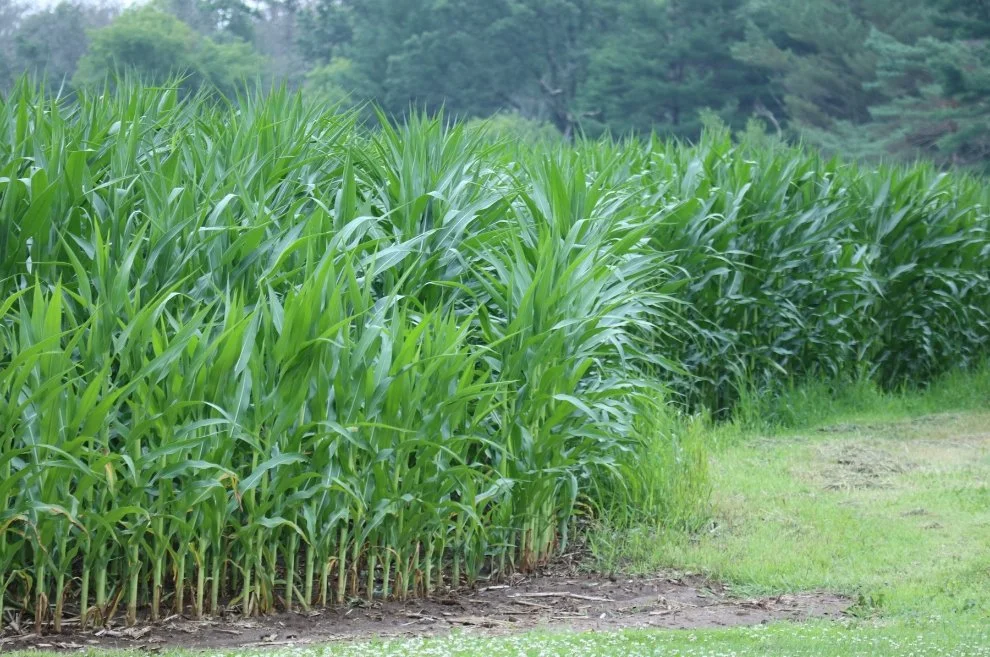
Last month, the Minnesota Department of Agriculture (MDA) opened a comment period on the use of neonicotinoid (nee-oh-nik-oh-TEE-noyd) treated seeds. We spent some time with a board member drafting a comment of our own. Along the way, we learned a lot about what’s ending up in our watershed, and wanted to share it with you.
A lot of the corn and soybean seed sold and planted across the Cannon River Watershed is coated with a pesticide most people have never heard of, and there’s a high likelihood it’s ending up in our rivers. We want you to be informed about this topic so that you’re ready to take action the next time an opportunity like this comes around.
Here's what we know.
What are neonics, exactly?
“Neonics” is short for neonicotinoids, a class of insecticides related to nicotine. They work by attacking an insect’s nervous system. Most neonics today aren’t sprayed on fields the way you might picture a crop duster working. Instead, they’re applied to the seed itself before it’s ever planted.
Seeds arrive at the distributor already coated with a neonic, usually clothianidin, imidacloprid, or thiamethoxam. The intention is to protect the seed once it's planted from soil-dwelling insects that might eat or damage it. Some research has found this to be entirely unnecessary.
How common is this in our area?
Very. Treated seed is now the default for most corn and a large share of soybeans sold in Minnesota. As a result, farmers are losing the ability to choose, under the guise that treated seed can serve as a sort of “insurance” against pests.
Southern Minnesota, where farming with tile drainage is the norm and rain washes fields into nearby streams, is one of the parts of the state where these chemicals most often turn up in surface water. And MDA does have data linking neonics to the Cannon and Straight Rivers.
What is turning up in Minnesota’s water?
The MDA regularly tests rivers and streams across the state for pesticides. In the most recent sampling, clothianidin showed up in 79 percent of samples and thiamethoxam in 9 percent, making clothianidin one of the most frequently found pesticides in Minnesota rivers and streams today, alongside common herbicides like 2,4-D and atrazine. Levels tend to spike after rainstorms, particularly in spring, during and right after planting. This lines up with the idea that these chemicals are washing off farm fields rather than drifting in from spraying.
Because of what the state was finding, in 2020 the MDA Commissioner officially labeled clothianidin and imidacloprid as "surface water pesticides of concern.” That designation exists because these chemicals are highly toxic to small aquatic creatures like insects and crustaceans, even at very low levels. The concerning news is that levels in rivers and streams regularly exceed the safety limits set for aquatic life every year.
Closer to home, the state’s Root River Field to Stream Partnership has been monitoring water quality in southeast Minnesota for years, and clothianidin and imidacloprid are consistently among the handful of pesticides found most often in that region’s water, a real concern for the area’s trout streams.
A separate study out of the University of Minnesota sampled 65 sites around the state and found that watersheds surrounded by farmland had noticeably more neonic pollution than watersheds in cities or in undeveloped land. That’s a direct link between the crops grown around a stream and what ends up in the water. Our watershed, being roughly 50 percent farmland, fits that pattern closely.
Why should we care?
It starts with bugs in the water.
This is part of the story scientists understand the best, because it’s been tested directly in controlled experiments, not just observed out in nature. Researchers have taken natural pools of water full of aquatic insects and added neonics at the kinds of levels commonly found in real rivers. The results were stark: at one common concentration, the variety of midge species in the water dropped by half, and at higher levels nearly everything but one tough species disappeared. In a related study, mayflies took one of the hardest hits of any insect group tested, with populations crashing by 98 percent at higher doses. You can read more about that research here.
This matters a lot for us, because mayflies are a big part of what indicates that our rivers are healthy. They’re especially sensitive to these chemicals, and exposure makes them weaker, less able to survive when oxygen levels dip, and easier for predators to catch. These pesticides also settle into the mud on the riverbed at even higher levels than in water itself, and mayfly nymphs (babies) live and feed right in that mud.
Then it affects the fish.
Bugs are food. When the bugs disappear, so does the food supply for everything that eats them. One of the clearest examples of this comes from a lake in Japan, where researchers tracked more than two decades of data and found that the year neonics were introduced to farms around the lake, the tiny water creatures that fish eat crashed by over 80 percent. Within a year, two commercial fish harvests collapsed along with them. You can read that study here.
That same chain- bugs decline, fish that eat bugs decline- is exactly the pathway that connects neonics to our local trout streams. Trout are a big part of what makes the Cannon River Watershed special, and trout eat aquatic insects.
Birds lose out too, in two different ways.
First, fewer bugs in general means less food for the many bird species that rely on insects, including birds that hunt over rivers for emerging mayflies. Researchers have pointed to pesticide use as one of the major reasons North America has lost nearly 3 billion birds, a 29 percent drop, since 1970.
Second, there’s a more direct route that has nothing to do with water at all. When treated seed spills on the ground during planting, birds that peck at that spilled seed can be poisoned outright.
Bees and other pollinators are exposed too.
Bees aren’t part of the river itself, but they live in the same farm landscape and are exposed to neonics through pollen, nectar, and dust kicked up during planting. Research has connected this exposure to weaker hives, shorter bee lifespans, and bees that struggle to remember flower locations or find their way home.
Bringing it all together
Our watershed is at least 50 percent farmland, and treated seed is the standard way most of that farmland gets planted. The state’s own water testing shows that these chemicals show up in Minnesota rivers and streams at levels that harm aquatic life, especially in farm-heavy areas like ours.
We hope this gives you a clearer picture of what’s happening in the watershed we all share. We’ll keep an eye out for the next chance to weigh in, and we’ll do our best to get that information to you with enough time to act on it.
Resources used to write this blog
Barmentlo, S. H., Schrama, M., de Snoo, G. R., van Bodegom, P. M., van Nieuwenhuijzen, A., & Vijver, M. G. (2021). Experimental evidence for neonicotinoid-driven decline in aquatic emerging insects. Proceedings of the National Academy of Sciences, 118(44). https://doi.org/10.1073/pnas.2105692118
Berens, M. J., Capel, P. D., & Arnold, W. A. (2021). Neonicotinoid Insecticides in Surface Water, Groundwater, and Wastewater Across Land‐Use Gradients and Potential Effects. Environmental Toxicology and Chemistry, 40(4), 1017–1033. https://doi.org/10.1002/etc.4959
Minnesota Department of Agriculture. (n.d.). Surface water pesticide water quality monitoring. In www.mda.state.mn.us. Retrieved July 30, 2026, from https://www.mda.state.mn.us/pesticide-fertilizer/surface-water-pesticide-water-quality-monitoring
Minnesota Department of Agriculture. (2019). Root River Field to Stream Partnership. In State.mn.us. https://www.mda.state.mn.us/root-river-field-stream-partnership
Minnesota Department of Agriculture. (2020). Surface water pesticides of concern. State.Mn.Us. https://www.mda.state.mn.us/surface-water-pesticides-concern
Minnesota Department of Agriculture. (2026). Neonicotinoid insecticides. In www.mda.state.mn.us. https://www.mda.state.mn.us/neonicotinoid-insecticides
Rosenberg, K. V., Dokter, A. M., Blancher, P. J., Sauer, J. R., Smith, A. C., Smith, P. A., Stanton, J. C., Panjabi, A., Helft, L., Parr, M., & Marra, P. P. (2019). Decline of the North American Avifauna. Science, 366(6461), 120–124. https://doi.org/10.1126/science.aaw1313
Tsvetkov, N., Samson-Robert, O., Sood, K., Patel, H. S., Malena, D. A., Gajiwala, P. H., Maciukiewicz, P., Fournier, V., & Zayed, A. (2017). Chronic exposure to neonicotinoids reduces honey bee health near corn crops. Science, 356(6345), 1395–1397. https://doi.org/10.1126/science.aam7470
Yamamuro, M., Komuro, T., Kamiya, H., Kato, T., Hasegawa, H., & Kameda, Y. (2019). Neonicotinoids disrupt aquatic food webs and decrease fishery yields. Science, 366(6465), 620–623. https://doi.org/10.1126/science.aax3442